


- EBMGS Modern
- October 22, 2026
- No Comments
UAE Eases E-Invoicing Rules: Businesses to Now Get More Flexibility, Time
With the 30 October deadline for appointing an e-invoicing provider less than ten days away, the UAE Ministry of Finance has loosened a few of the system’s rules. The amendments give some businesses more time, let companies keep their e-invoice records outside the UAE, and remove the “system failure” provisions from the framework. It’s welcome news, but it’s narrow. Two big things haven’t changed: the provider-appointment deadline and the January 2027 go-live. Here’s what the amendments do, who benefits, and what to do now.
Background: Where the E-Invoicing Programme Stands Expert Recommendations
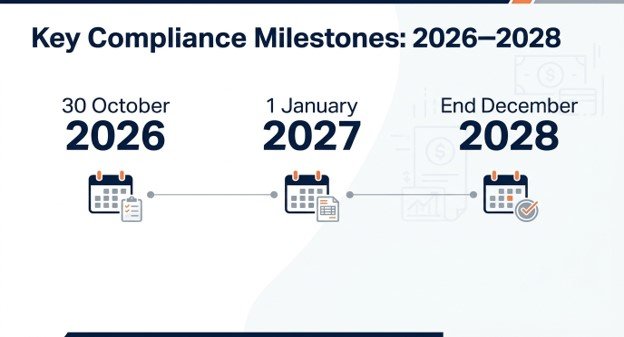
The UAE’s electronic invoicing system is being introduced in phases. Qualifying transactions are validated and transmitted through accredited service providers, rather than simply sent from one company to another. Businesses with annual revenue of AED 50 million or more must appoint an accredited provider by 30 October 2026 (the date was extended from 1 July), with the system going live for larger businesses from 1 January 2027. Earlier this month, the Ministry changed the provider side of the system. Ministerial Decision No. 168 of 2026 replaced “pre-approval” with direct accreditation, which we covered in a separate article. The new changes work on the business side. They come through Ministerial Decision No. 197 of 2026, which amends Ministerial Decision No. 243 of 2025 on the Electronic Invoicing System and took effect on 1 October 2026. The Ministry says the amendments aim to reduce operational burdens, give greater flexibility during implementation, and keep regulatory requirements business-friendly.
- Collaboratively unleash performance based schemas
- Enthusiastically optimize revolutionary architectures alone
-
Phosfluorescently synergize e-business alignments next
What Changed: Three Amendments
|
Area |
Before |
After Decision 197 of 2026 |
|
Transactions within a tax group |
Covered by the e-invoicing system |
Treated as “excluded transactions” for 24 months from 1 January 2027 (to end of December 2028) |
|
Storage of e-invoice data |
Invoices, credit notes and data had to be stored in the UAE |
No in-UAE requirement; records must be retained for the Tax Procedures Law period and provided to the FTA on request |
|
“System Failure” provisions |
Included in the framework |
Removed |
1.Tax group relief for 24 months
Transactions between members of the same tax group will be excluded from the system for two years starting 1 January 2027. The Ministry says this gives affected businesses “greater flexibility and more time to adapt to the system.” For groups with heavy intercompany invoicing, that’s a real reduction in early workload.
2.Overseas data storage
The requirement to store e-invoice and credit note data inside the UAE has been removed. The focus has shifted from where records are kept to whether they are retained and accessible. Businesses must keep all electronic invoices, credit notes and associated data for the period set out in the Tax Procedures Law, and be able to give them to the Federal Tax Authority (FTA) on request.
3.System failure provisions removed
The decision also removes the provisions on “System Failure.” Dubai Standard reports that this means fewer reporting obligations when technical issues disrupt a business’s e-invoicing system. The sources I found don’t spell out what, if anything, replaces those provisions, so check the decision text before relying on this.
What Hasn’t Changed
- The 30 October deadline. Businesses with annual revenue of AED 50 million or more still need to appoint an accredited service provider.
- The January 2027 go-live for larger businesses.
- The broader requirement to comply. Coverage of the amendments stresses that they don’t remove the obligation for businesses in the system to follow the rules.
- Transactions outside the tax group. The exclusion covers only transactions between members of the same tax group.
The Open Question: Invoices to Outside Parties
David Daly, a partner at Gulf Tax Accounting Group, called the changes “welcome” but said more clarity is needed. In particular, it’s unclear whether invoices that tax group members send to counterparties outside the group must go through the e-invoicing system. Until the Ministry clarifies, the cautious assumption (my inference, not an official position) is that external invoices should be treated as in scope.
There’s a second definitional point worth confirming: the sources say “tax group” without spelling out whether this means a VAT group, a corporate tax group, or both. Confirm which definition applies to you before relying on the exclusion.
Step-by-Step: What to Do Now
1. Confirm your 30 October position
If revenue is AED 50 million or more, appoint an accredited provider on time. The amendments don’t change this.
2. Check your provider’s status
Following Decision No. 168, providers must complete accreditation, not just hold pre-approval. Ask for written confirmation.
3. Map your tax group transactions
If you’re part of a tax group, list intercompany invoice flows and separate them from invoices to outside parties.
4. Decide your 2027 approach for group invoicing
The exclusion is temporary. Use the 24 months to design processes, not to postpone them.
5. Review where you store invoice data
If you’ve been planning in-UAE hosting purely to meet the old rule, revisit the plan. Check your contracts and any data-protection obligations that apply to storing financial records abroad. That check is my suggestion, not a requirement in the decision.
6. Keep FTA access simple
Whatever your storage location, make sure you can produce records promptly on request.
Benefits of the Amendments
-
More preparation time for tax groups, until the end of December 2028
- Lower infrastructure constraints, since storage location is no longer fixed to the UAE
- Potentially simpler incident handling, with the system failure provisions removed
- A clearer focus on retention and access, instead of geography
Eligibility & Requirements
-
- Tax group relief: applies to transactions between members of the same tax group, for 24 months from 1 January 2027.
- Storage flexibility: applies to businesses subject to the system.
- Retention: all e-invoices, credit notes and related data must be kept for the Tax Procedures Law period and available to the FTA on request.
- Provider appointment: still required for businesses with revenue of AED 50 million or more by 30 October 2026.
Costs & Timeline
No cost figures were published with the amendments. Savings, if any, would depend on your setup. Flexibility on storage may reduce hosting constraints, but you will still need provider fees and system integration.
|
Date |
Milestone |
|
1 October 2026 |
Decision No. 197 of 2026 takes effect |
|
30 October 2026 |
Appointment deadline for businesses with AED 50m+ revenue |
|
1 January 2027 |
System go-live for larger businesses; tax group exclusion begins |
|
End of December 2028 |
Tax group exclusion period ends |
Latest UAE Updates
-
Decision No. 197 of 2026 amends the Electronic Invoicing System decision (No. 243 of 2025), with the changes announced this week.
- Decision No. 168 of 2026 moved providers from pre-approval to direct accreditation, with existing providers given 30 days to comply.
- Industry reaction is positive but cautious, with calls for further guidance on how the tax group exclusion works in practice.
Common Mistakes to Avoid
- Treating the amendments as a deadline extension. The 30 October date remains.
- Assuming all group invoices are excluded. Only transactions between tax group members qualify, and external invoices are unclear.
- Forgetting the exclusion ends. It runs only to the end of December 2028.
- Moving data abroad without a retention plan. You still need to produce records on request.
- Ignoring provider status. Under the new accreditation regime, pre-approval and accreditation aren’t the same.
- Relying on press summaries alone. Read the decision text or take professional advice for edge cases.
Expert Tips
- Document your tax group structure and the legal basis for treating intercompany invoices as excluded.
- Build your e-invoicing design now for group and non-group flows, so that when the exclusion ends there’s no scramble.
- If you use cloud storage abroad, confirm retrieval speed and access controls for FTA requests.
- Keep a record of your provider’s accreditation status and the date you confirmed it.
- Ask your adviser whether any pending Ministry guidance affects your group.
Frequently Asked Questions
What changed in the UAE’s e-invoicing rules?
Ministerial Decision No. 197 of 2026 introduces a 24-month exclusion for transactions between tax group members, removes the requirement to store e-invoice data in the UAE, and removes the “system failure” provisions.
1.When does the tax group exclusion start and end?
It starts on 1 January 2027 and runs for 24 months, until the end of December 2028.
2.Can I store e-invoice data outside the UAE now?
Yes, the in-UAE storage requirement has been removed, but you must retain the data for the period in the Tax Procedures Law and provide it to the FTA on request.
3. Has the 30 October deadline been extended again?
No. Businesses with annual revenue of AED 50 million or more must still appoint an accredited provider by 30 October 2026.
4.When does e-invoicing go live?
From 1 January 2027 for larger businesses.
5.Are invoices between tax group members completely exempt?
They’re treated as excluded transactions for 24 months, which is temporary relief rather than permanent exemption.
Do invoices from a tax group member to an outside customer need to go through the system?
It’s unclear. A Gulf Tax Accounting Group partner has asked for clarification, and the cautious assumption is that they do.
What happened to the “system failure” provisions?
They have been removed from the framework. Reports suggest fewer reporting obligations when technical issues occur, but check the decision text for specifics.
How is this related to Decision No. 168?
Decision No. 168 deals with how providers are accredited. Decision No. 197 amends the business-side rules.
9. Do the amendments cut costs?
No cost figures were published. Flexibility on storage may help, but provider fees and integration costs remain.
Conclusion: Useful Breathing Room, Not a Pause Button
The amendments are practical: more time for tax groups, fewer geographic constraints on data, and a lighter framework around system failures. They don’t change the October deadline or the January go-live. The best use of the flexibility is to prepare early, not to wait.
Elite Business Management Services helps businesses confirm their e-invoicing obligations, review tax group structures, vet providers, and plan systems and data storage ahead of go-live. Contact Elite Business Management Services today to make sure you’re ready before 30 October.