
Complete Guide to Starting a Business in the UAE (2026)
Every year, thousands of entrepreneur’s land in Dubai and Abu Dhabi with the same question: is starting a business in the UAE really as simple as the ads make it look?
The honest answer is - mostly yes, but only if you understand the moving parts before you sign anything.
Since 2023, the UAE has layered a federal corporate tax regime on top of its famously business-friendly setup process, and 2026 has brought further refinements to free zone tax exemptions, visa rules, and licensing procedures.
This guide walks through UAE business setup from the ground up: how to choose a jurisdiction, what it actually costs in 2026, how corporate tax applies to your structure, and the mistakes that trip up first-time founders.
Whether you're a solo consultant, a trading company, or a tech startup planning to scale across the Gulf, this is the practical roadmap.
Why the UAE Still Attracts Global Founders
The UAE built its reputation on a simple pitch: no personal income tax, 100% foreign ownership, world-class infrastructure, and a location that sits within an eight-hour flight of two-thirds of the world's population.
That pitch still holds in 2026, even with corporate tax now part of the picture.
A few things have genuinely changed the landscape over the past few years.
Ownership & Regulatory Evolution
Federal Decree-Law No. 32 of 2021 removed the old requirement for a UAE national majority shareholder on most mainland activities, which means most mainland companies can now be 100% foreign-owned - a shift that used to be the exclusive advantage of free zones. Meanwhile, the introduction of federal corporate tax in June 2023 means the UAE is no longer a blanket "tax-free" jurisdiction - but for the right structure, it can still be close to one.
Add to that an expanded Golden Visa program, faster digital licensing through platforms like Dubai's Invest in Dubai portal, and a business ecosystem with over 45 free zones catering to everything from crypto to logistics, and it's easy to see why the UAE remains one of the most active company-formation markets in the world.
Background: Mainland, Free Zone, or Offshore?
Before anything else, you need to decide where your company will legally sit. The UAE gives you three broad options, and this decision shapes almost everything downstream - your cost, your tax exposure, your visa quota, and who you're allowed to sell to.
| Structure | Ownership | Market Access | Typical Use Case |
|---|---|---|---|
| Mainland (DED/DET license) |
100% foreign ownership permitted in most sectors | Trade freely across the UAE and internationally | Retail, restaurants, clinics, contracting, businesses serving local customers |
| Free Zone (45+ zones) |
100% foreign ownership | Operate within the zone and internationally; mainland sales need a distributor | Consulting, trading, tech, media, fintech, holding companies |
| Offshore (e.g., JAFZA, RAK ICC) |
100% foreign ownership | No UAE trading; used for holding assets or international business | Asset holding, international invoicing, IP holding structures |
Mainland companies are licensed by each emirate's Department of Economy and Tourism (in Dubai, this is DET; formerly DED) and can trade anywhere in the UAE without restriction. Free zone companies are licensed by the individual free zone authority - DMCC, IFZA, RAKEZ, DIFC, ADGM, and dozens of others - and historically couldn't sell directly to the UAE mainland without going through a licensed distributor. That restriction still applies in 2026.
The right choice comes down to one question: who are you actually selling to? If your customers are mostly outside the UAE or you're building a digital/consulting business, a free zone usually wins on cost and tax efficiency. If you need a shop, a clinic, a restaurant, or you're bidding on UAE government or mainland contracts, mainland is usually the only workable path.
Step-by-Step Guide to Starting a Business in the UAE
Define Your Business Activity
Every UAE license is tied to specific, pre-approved business activities - you can typically bundle 10–15 activities under one license, but they need to belong to compatible categories. Getting this wrong is one of the most common causes of delay.
Choose Your Jurisdiction and Legal Structure
Decide between mainland and free zone based on the table above, then pick your legal form - typically a Limited Liability Company (LLC) for mainland, or a Free Zone Extablishment (FZE) or Free Zone Company (FZCO).
Reserve a Trade Name
Your company name must be unique, avoid religious or political references, and generally can't use terms like "Dubai" without special permission. Name approval is usually processed within a day.
Apply for Initial Approval and Draft Your MOA
Initial approval confirms the government has no objection to you starting the business. For mainland LLCs, you'll also need a Memorandum of Association (MOA) outlining shareholding structure.
Secure Office Space
Mainland licenses require physical office space - the size directly determines your visa quota (commonly 1 visa per 2 sqm for professional/service activities). Free zones offer more flexibility, from shared "flexi-desks" to dedicated offices, depending on the zone and package.
Submit Documents and Pay License Fees
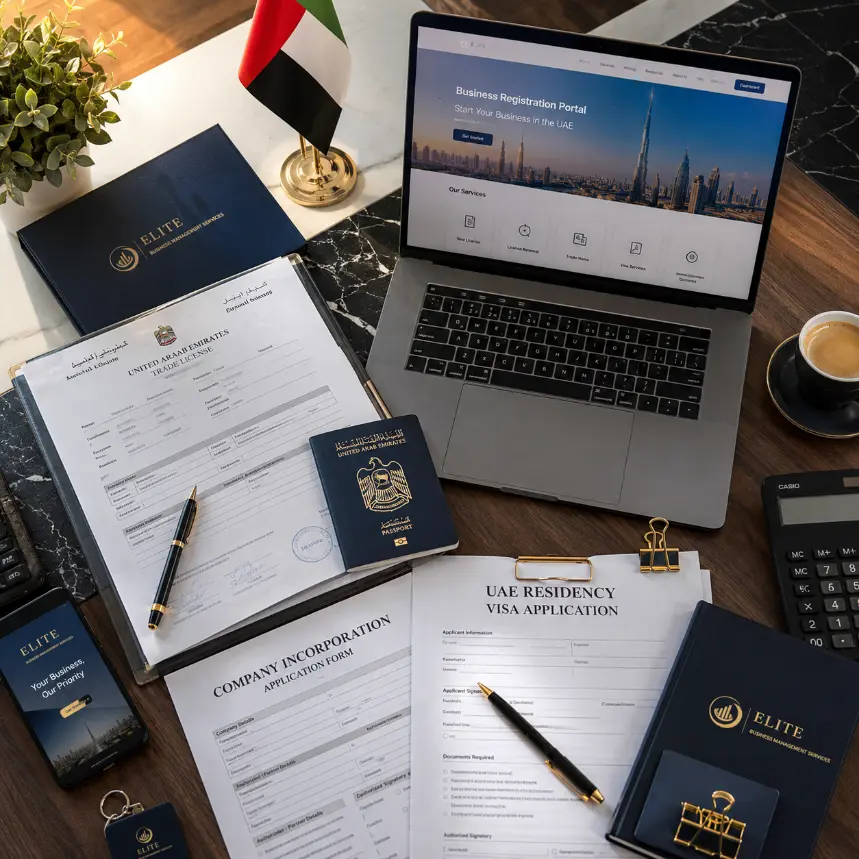
Submit your application with passport copies, MOA, tenancy contract (Ejari for mainland), and any activity-specific approvals (for regulated activities like healthcare, education, or financial services).
Register for Corporate Tax and VAT
Corporate tax registration through the Federal Tax Authority's EmaraTax portal is mandatory for every licensed entity, within three months of incorporation. If your taxable turnover exceeds AED 375,000 annually, VAT registration is required.
Open a Corporate Bank Account
This has become one of the more time-consuming steps in 2026, with banks applying stricter due diligence. Expect the process to take anywhere from two to eight weeks depending on your business profile.
Apply for Visas
Once your license is issued, you can apply for investor/partner visas and employee visas, which involve medical fitness testing, Emirates ID registration, and biometric data collection.
Benefits of Starting a Business in the UAE
- Full foreign ownership in most mainland and all free zone sectors - no local sponsor required for most activities.
- 0% personal income tax on salaries and dividends.
- Potential 0% corporate tax for qualifying free zone companies (Qualifying Free Zone Person status).
- Fast incorporation - many free zone licenses can be issued within days once documents are in order.
- Strategic location bridging Europe, Asia, and Africa, with world-class logistics and aviation infrastructure.
- Residency visa access for owners, employees, and dependents, including the expanded Golden Visa program.
- No currency restrictions and full repatriation of profits and capital.
Eligibility & Requirements
Most nationalities are eligible to set up a UAE company, though a handful of regulated or "strategic" activities (defense, security, certain financial services) may still require government approval or a local partner. Generally, you'll need:
Minimum share capital requirements vary: a UAE mainland LLC typically has a minimum declared share capital of AED 50,000 (though it usually doesn't need to be paid in upfront for most activities), while most free zones like DMCC or Meydan have no minimum share capital requirement at all.
Costs & Timeline in 2026
Costs vary significantly by jurisdiction, activity, and visa count, but here's a realistic range for a single-founder company with one visa.
| Item | Mainland | Free Zone |
|---|---|---|
| License & registration | AED 12,000 – 25,000 | AED 11,900 – 35,000 |
| Office space (annual) | AED 15,000 – 40,000+ (mandatory) | AED 0 – 15,000 (flexi-desk options available) |
| Visa (per person) | AED 3,500 – 7,000 | AED 3,500 – 7,000 |
| Bank account setup assistance (optional) | AED 2,000 – 5,000 | AED 2,000 – 5,000 |
| Typical Year 1 total (1 visa) | AED 30,000 – 45,000 | AED 18,000 – 35,000 |
Timeline: A straightforward free zone license can be issued in as little as 3–7 working days. Mainland setups usually take 3–6 weeks from name reservation to license issuance, mainly due to office leasing (Ejari registration) and, in some cases, additional activity approvals. Corporate bank account opening now typically adds another 3–8 weeks on top of that.
Ongoing annual costs to budget for: license renewal (roughly 70–100% of the initial license fee), office rent renewal, visa renewals every 2–3 years, health insurance (AED 800–1,500 per visa holder per year), and accounting/audit fees (AED 3,000–36,000 per year depending on complexity and whether you're near the corporate tax threshold).
Latest UAE Updates for 2026
Corporate Tax Enforcement
Corporate tax enforcement has matured. The 9% corporate tax on profits above AED 375,000 is now fully embedded in FTA compliance checks. Late corporate tax registration carries a flat AED 1,000 penalty (rising to AED 5,000 for repeat violations), and late filing accrues AED 500/month for the first 12 months.
Small Business Relief Status
Small Business Relief still lets businesses with revenue under AED 3 million elect to be treated as having zero taxable income, but this transitional relief is currently legislated only through tax periods ending on or before 31 December 2026 - so newer businesses relying on it should plan for its eventual phase-out.
Qualifying Free Zone Person (QFZP) Scrutiny
Qualifying Free Zone Person (QFZP) scrutiny has increased. The FTA is now more document-driven in verifying that free zone companies maintain genuine substance, earn qualifying income, and stay under the de minimis threshold (the lower of AED 5 million or 5% of revenue from non-qualifying mainland income). Cross that line, and you lose QFZP status for the current period plus the following four years - a steep penalty for a single mainland invoice.
Golden Visa Broadening & Quotas
Golden Visa eligibility has broadened significantly. 2025–2026 reforms added categories for content creators, AI specialists, climate-tech entrepreneurs, and long-serving nurses and teachers, while the property investment threshold for the 10-year Golden Visa rose to AED 2 million (the separate 2-year investor visa dropped its minimum property value requirement entirely). Office-linked visa quotas have loosened slightly in some emirates, with mainland ratios moving from 1 visa per 3 sqm to 1 visa per 2 sqm for professional and service activities in certain zones - worth checking with your specific authority.

Conclusion: Get Your UAE Business Set Up the Right Way
Starting a business in the UAE in 2026 is still one of the fastest, most founder-friendly paths to building an international company - but the margin for error has narrowed. Between corporate tax compliance, QFZP conditions, evolving visa rules, and jurisdiction-specific licensing quirks, a wrong turn early on can cost far more than the setup fee ever would.
Ready to Launch Your Venture Without the Paperwork?
That's exactly where the right advisory partner earns its keep. Elite Business Management Services works with founders across mainland, free zone, and offshore structures to handle licensing, corporate tax registration, banking introductions, and visa processing end-to-end - so you spend your time building the business, not chasing paperwork. If you're ready to set up in the UAE the right way, get in touch with Elite Business Management Services today for a tailored consultation on the structure that fits your business.









Leave a comment