


- EBMGS Modern
- October 23, 2026
- No Comments
UAE Federal Tax Authority Issues Guide on Multinational Enterprise Top-Up Tax
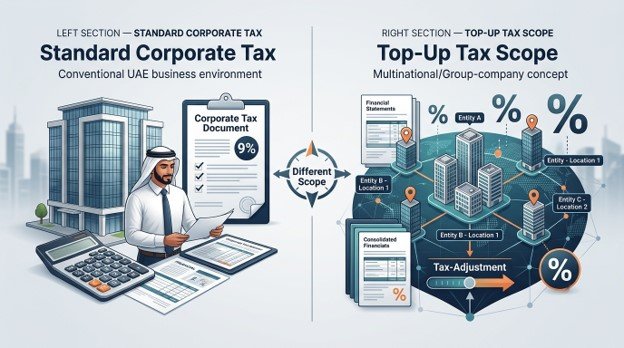
For most UAE businesses, corporate tax is a 9% conversation. For a much smaller group of very large multinationals, there’s a second conversation running alongside it, and it just got a lot easier to follow. The Federal Tax Authority (FTA) has issued a new Top-up Tax Guide on Scope and Registration, explaining how the UAE’s Qualified Domestic Minimum Top-up Tax (QDMTT) applies to multinational enterprise (MNE) groups and what registration involves.
If your group is anywhere near the reporting threshold, this guide is worth reading closely. If it isn’t, it’s still worth understanding, because it explains why a UAE entity can pay more than the headline 9% (or 0%) rate you’read about elsewhere.
Background: What the Top-Up Tax Is and Why the UAE Introduced It
The top-up tax is the UAE’s local implementation of Pillar Two, part of the OECD/G20 Two-Pillar Solution on the tax challenges of the digital economy. Pillar Two’s GloBE Model Rules aim to make sure large multinational groups pay an effective tax rate of at least 15% in every jurisdiction where they operate.
The UAE’s regular corporate tax sits at 9% (and 0% for qualifying free zone income), so an in-scope group’s UAE profits can fall below the 15% floor. Without a domestic mechanism, another country could collect the shortfall under its own Pillar Two rules. The QDMTT lets the UAE collect that top-up itself, preserving its primary taxing right over profits earned here. It’s assessed at the UAE jurisdictional level and sits separately from the standard corporate tax regime.
The UAE’s legislation applies to fiscal years beginning on or after 1 January 2025, and the country was listed in the OECD’s central record in August 2025 with “transitional qualified” status.
What the FTA’s New Guide Covers
According to the FTA’s announcement, the guide:
- Helps MNE groups determine whether they fall within the scope of the QDMTT legislation
- Explains the conditions for a group to be in scope, and which entities are subject to top-up tax and which aren’t
- Outlines the registration process and applicable timelines
- Is aimed at the people responsible for tax affairs of entities that may belong to an MNE group, as well as tax agents
The FTA stresses that the guide should be read in its entirety, since definitions, requirements, and the interaction between different rules only make sense together. It’s available on the FTA’s official website.
Who Is in Scope?
Investment entities, among other excluded
Factor Detail Revenue threshold Consolidated group revenue of €750 million or more (roughly AED 3 billion) in at least two of the four fiscal years immediately preceding the relevant year Minimum rate 15% effective tax rate on UAE profits Who it applies to UAE-headquartered and foreign-headquartered groups with UAE constituent entities Free zone entities Can be caught: if an in-scope free zone entity’s group-level ETR is below 15%, a top-up may apply Commonly excluded Investment entities, among other excluded categories
Most SMEs and mid-sized companies are nowhere near this threshold and won’t be affected.
Step-by-Step: How an MNE Group Should Approach Compliance
-
Test the revenue threshold: Check whether consolidated group revenue meets €750 million in at least two of the previous four fiscal years, and identify every UAE constituent entity in the group.
-
Check exclusions and reliefs: Review whether any entities are excluded (such as investment entities) and whether relief might apply. Reported features of the regime include a substance-based income exclusion tied to payroll and tangible assets, a de minimis exclusion for smaller operations, and transitional relief in limited circumstances.
-
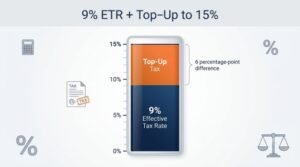
Calculate the UAE effective tax rate: Work out the jurisdictional ETR on UAE profits. If the result is below 15%, the shortfall is the potential top-up tax. For example, a 10% ETR points to a 5% top-up on adjusted profits.
-
Register through EmaraTax: The FTA has enabled top-up tax registration on its EmaraTax portal. Use the new guide to confirm the registration requirements and timelines that apply to your group.
-
Prepare filings and records: In-scope groups should expect to file a GloBE Information Return and maintain supporting records. Records used to determine your top-up tax position should be kept for seven years from the end of the relevant tax period.
-
Coordinate with global tax teams: Because the UAE’s QDMTT interacts with other countries’ Pillar Two rules, UAE decisions should be aligned with the group’s global tax compliance, not handled in isolation.
Benefits of Getting This Right
- Fewer surprises in the group’s global tax position, since a properly applied QDMTT keeps the top-up in the UAE.
- Clearer registration obligations, now that the FTA has published dedicated guidance on scope and timelines.
- Reduced penalty risk, as non-compliance sits within the UAE’s corporate tax penalty regime.
- Better planning around free zone incentives, which don’t fully shield in-scope groups from the 15% floor.
- A stronger audit trail, if documentation is organised from the start.
Eligibility & Requirements Checklist
Group consolidated revenue of at least €750 million in two of the last four fiscal years.
At least one UAE constituent entity.
Entity-level review against the exclusions in the QDMTT legislation.
EmaraTax access for registration.
Accounting data capable of supporting a GloBE-style ETR calculation.
Seven-year record retention in place.
Costs & Timeline
| Item | What to Know |
|---|---|
| Top-up tax rate | Difference between the UAE ETR and 15%, applied to adjusted profits |
| Registration deadline | Earlier reporting indicated no specific deadline had been prescribed; the new guide outlines timelines, so confirm the current position directly in the guide |
| Record retention | Seven years from the end of the relevant tax period |
| Advisory and systems cost | Varies with group size and the complexity of ETR calculations |
Latest UAE Updates
Official FTA Guidance Released: The FTA has issued its Top-up Tax Guide on Scope and Registration, giving in-scope groups the clearest official explanation yet of how scope and registration work.
EmaraTax System Capability: EmaraTax now supports Pillar Two top-up tax registration, with registration described as allowed now and required in due course.
OECD Global Recognition: The UAE’s transitional qualified status in the OECD’s central record (August 2025) signals alignment with the global framework.
Standard Regimes Preserved: Small Business Relief and the standard 9% regime are unchanged, and the top-up tax doesn’t replace them. It applies on top, only to in-scope groups.
Common Mistakes to Avoid
- Assuming a free zone 0% rate settles the question: For an in-scope group, the 15% floor can still produce a top-up.
- Treating QDMTT as ordinary corporate tax: Treating the QDMTT as part of ordinary corporate tax filing. It’s a separate assessment with its own scope and registration rules.
- Testing threshold on UAE revenue alone: Testing the threshold on UAE revenue alone. The €750 million test is applied to consolidated group revenue worldwide.
- Skimming the guide: Skimming the guide. The FTA itself says it should be read in full, because the rules interact.
- Leaving registration to the last minute: Leaving registration to the last minute just because no deadline was announced earlier. Timelines may now be clearer, so check.
- Relying on older summaries: Relying on older summaries. Some commentary online gives 2026 as the start year, while the legislation refers to fiscal years beginning on or after 1 January 2025.
Expert Tips
- Run a quick scoping exercise now, even if you think the group is below the threshold. Revenue grows, and the test looks back over four years.
- Build the ETR calculation into your normal close process rather than as a year-end project.
- Document substance (payroll and tangible assets) carefully, since it feeds the income exclusion.
- Align UAE positions with the group’s global Pillar Two model so you aren’t reconciling conflicting numbers later.
- Speak to a registered tax agent before registering. Mistakes in group structure data are harder to fix once submitted.
Frequently Asked Questions
1. What is the UAE top-up tax?
It’s the UAE’s Qualified Domestic Minimum Top-up Tax, which ensures in-scope multinational groups pay at least 15% effective tax on their UAE profits.
2. Who has to pay it?
MNE groups with consolidated revenue of at least €750 million in at least two of the four preceding fiscal years that have UAE constituent entities.
3. Does it apply to small and medium businesses?
No. Businesses below the group revenue threshold are outside its scope and continue under the standard corporate tax rules.
4. Does the top-up tax replace UAE corporate tax?
No. It operates alongside it. The 9% rate and the 0% qualifying free zone rate still apply, with a top-up potentially due where the effective rate falls below 15%.
5. Are free zone companies exempt?
Not if they’re part of an in-scope group. A free zone entity’s low effective rate can trigger a top-up.
The FTA’s new guide doesn’t change who’s in scope — it makes the rules easier to apply. For the small number of large groups affected, it’s the clearest route yet to understanding scope, exclusions, and registration. For everyone else, it’s a reminder that the UAE’s tax landscape now has two layers.
Ensure Complete Pillar Two & Corporate Tax Compliance
Elite Business Management Services helps businesses assess whether the top-up tax applies, review group structures, and handle registration and ongoing compliance with the FTA. Contact Elite Business Management Services today for a scoping review before deadlines become a problem.