

- EBMGS Modern
- October 23, 2026
- No Comments
UAE Scraps E-Invoicing Pre-Approval Ahead of October Deadline: Here’s Why
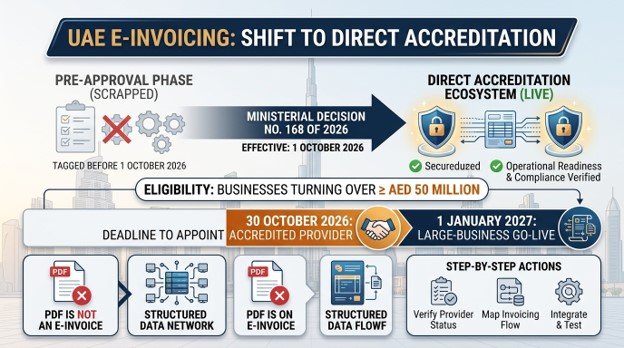
If your business turns over AED 50 million or more, you have until 30 October 2026 to appoint an accredited e-invoicing provider. That deadline hasn't moved. What has moved is the ground under the providers you might be choosing from. The UAE Ministry of Finance has removed the "pre-approval" stage for e-invoicing service providers and replaced it with direct accreditation, effective 1 October 2026.
It sounds like a technicality, and for providers it is a big one. For businesses, it raises a practical question: is the provider I'm about to sign actually accredited, or just pre-approved? Here's what changed, why, and what to do with the time left.
Background: How the UAE's E-Invoicing System Is Being Built
The UAE is moving to a unified e-invoicing model. Under it, qualifying business-to-business (B2B) transactions are validated and transmitted through an accredited third-party provider, not simply sent between companies. The framework starts with B2B and business-to-government (B2G) transactions, as part of a wider digital tax transformation aimed at transparency, fewer manual reporting errors, and near real-time visibility of transactions.
Key Distinction: One point trips up many finance teams — a PDF is not an e-invoice. Producing an invoice on a computer and emailing it doesn't meet the requirement. The invoice has to be structured data that passes through the accredited network.
Until now, providers could enter the market through a preliminary approval route. That was a development-stage measure, designed to onboard providers while the technical infrastructure and interoperability arrangements were still being built and tested.
What Changed: Ministerial Decision No. 168 of 2026
Ministerial Decision No. 168 of 2026 took effect on 1 October 2026 (it was publicly announced on 9 October). It repeals Ministerial Decision No. 64 of 2025 and its amendments, including Decision No. 56 of 2026. Its main points:
- Pre-approval is gone: Providers must complete the required accreditation assessments and testing before they receive approval to operate.
- A 30-day transition applies: Providers that held preliminary approval before 1 October have up to 30 days from that date to meet the new requirements. They don't need a fresh application unless the Ministry says otherwise.
- Preliminary approval ends if missed: Preliminary approval ends if the deadline is missed.
- Peppol and outsourcing provisions stay: Providers can still use third-party Peppol service provider products and outsource development, operation, management, or elements of their e-invoicing services.
Why the UAE Scrapped Pre-Approval
The Ministry's stated reason is that the programme is moving from development and testing into a fully operational, live ecosystem. Pre-approval made sense while the system was being built. In a live system, the Ministry wants providers to show technical capability, operational readiness, and compliance before accreditation, not after.
There's also a market reality behind it. The appointment deadline was already extended once, from July to 30 October 2026, after a readiness review found the pool of accredited providers too small for demand. Gulf News reports that only about 50 providers nationally are accredited or pre-approved. With that few providers and a deadline closing in, the difference between "pre-approved" and "accredited" matters.
Key Dates at a Glance
| Date | What Happens |
|---|---|
| 1 October 2026 | Decision No. 168 takes effect; 30-day transition starts for preliminarily approved providers |
| About 31 October 2026 | Transition window closes; preliminary approval ends for providers that haven't completed accreditation |
| 30 October 2026 | Businesses with annual revenue of AED 50 million or more must appoint an accredited provider |
| 1 January 2027 | Large-business e-invoicing implementation date (unchanged) |
| 1 July 2027 | Small-business implementation date |
| 1 October 2027 | Government-entity implementation date |
Step-by-Step: What Your Business Should Do Now
-
1Confirm whether you're in scope: If annual revenue is AED 50 million or more, the 30 October appointment deadline applies to you. Smaller businesses have later implementation dates, but the selection process for providers is the same, so starting early helps.
-
2Ask every provider for their exact status: Request written confirmation of whether they are fully accredited, preliminarily approved and mid-transition, or still applying. Don't accept "approved" as an answer on its own.
-
3Check the transition risk: A provider's preliminary approval can lapse about a month after 1 October if accreditation isn't completed. Ask what happens to your onboarding if their status changes, and confirm with the Ministry if you're unsure how it affects your own compliance.
-
4Map your invoicing flow: List your invoice types, volumes, systems (ERP, accounting software), and who produces what. Integration complexity is usually the longest part of the project.
-
5Sign, integrate, and test: Appointment is the deadline, but the January 2027 go-live is the real test. Run test invoices before routine billing depends on the system.
-
6Align tax and finance teams: E-invoicing touches VAT reporting, corporate tax records, and IT. Assign one owner so decisions don't stall.
Benefits of Getting It Right
Compliance Confidence
Avoid appointing a provider whose status is shaky.
Cleaner Records
Structured invoice data feeds VAT and corporate tax workflows more accurately.
Fewer Manual Errors
Validation happens directly at the point of invoice issue.
Smoother Go-Live
Early testing significantly reduces operational disruption in January.
Better Vendor Leverage
With provider capacity limited, early movers negotiate terms from a much stronger position.
Eligibility & Requirements
- Who must appoint by 30 October: Businesses with annual revenue of AED 50 million or more.
- What you need: A contract with an accredited service provider, integration with your invoicing or ERP systems, and a testing plan.
- What to verify: Your provider's accreditation status, Peppol capability (if relevant to your integration), and support for your volumes and systems.
Costs & Timeline Snapshot
Provider pricing varies by invoice volume, integration complexity, and the provider's model — request itemised quotes covering onboarding, integration, per-invoice or subscription fees, and support.
| Item | What to Know |
|---|---|
| Provider fees | Vary widely; request itemised written quotes |
| Integration effort | Depends on ERP system setup and invoice volume |
| Appointment deadline (large businesses) | 30 October 2026 |
| Go-live (large businesses) | 1 January 2027 |
| Realistic planning window | Under three weeks to appointment, so shortlist now |
Latest UAE Updates for 2026
- ✔ Decision No. 168 of 2026 in Force: Decision No. 168 of 2026 is now in force, ending pre-approval in favour of direct accreditation.
- ✔ 30 October Deadline Stands: The 30 October appointment deadline stands. Gulf News coverage citing the FTA's 29 September confirmation describes it as the current deadline, with 1 January 2027 unchanged for implementation. Advisers such as Tax Star are urging businesses to treat it as final.
- ✔ Pilot Phase Concluded: The pilot phase has ended in practice. The Ministry describes the programme as now being a live operating system.
Common Mistakes & Expert Tips
Common Mistakes to Avoid:
- Treating "approved" and "accredited" as identical: Under the old framework, preliminary approval and completed accreditation were different stages.
- Waiting for another extension: It was extended once, and advisers are warning against assuming it will be extended again.
- Confusing PDF invoicing with e-invoicing: Emailing a PDF doesn't meet the requirement.
- Leaving integration until January: Testing takes time, and ERP changes rarely go smoothly under deadline pressure.
- Ignoring provider capacity limits: With about 50 providers nationwide, popular ones may be stretched.
- Not documenting the selection decision: Keep your selection rationale and the provider's status evidence on file.
Expert Tips:
- Ask providers for their accreditation reference and the date it was granted, and keep it in your compliance file.
- Run a small pilot with a subset of invoices before full rollout.
- If your group has several UAE entities, check whether each needs its own appointment and who owns each.
- Involve your accountant and IT team in the same meeting so tax logic and technical logic match.
- Keep a contingency: know your second-choice provider in case your first changes status.
Frequently Asked Questions
1. What did the UAE change about e-invoicing?
The Ministry of Finance removed the pre-approval stage for e-invoicing service providers and replaced it with direct accreditation under Ministerial Decision No. 168 of 2026.
2. When did the new rules take effect?
1 October 2026.
3. Why was pre-approval scrapped?
The programme is moving from development and testing into a fully operational ecosystem, so providers now need to complete assessment and testing before being accredited.
4. What is the 30 October deadline?
Businesses with annual revenue of AED 50 million or more must appoint an accredited e-invoicing service provider by that date.
5. When does e-invoicing go live for large businesses?
1 January 2027.
6. What happens to providers that were preliminarily approved?
They have up to 30 days from 1 October 2026 to meet the new accreditation requirements, or their preliminary approval is terminated.
7. How can I check whether my provider is accredited?
Ask for written confirmation and the accreditation reference, and verify with the Ministry of Finance if in doubt.
8. Is a PDF invoice enough?
No. E-invoicing requires structured electronic data transmitted through the accredited framework.
9. Does this affect small businesses?
Smaller businesses have later implementation dates, but the provider market and standards are the same, so early preparation helps.
10. Can providers still use Peppol and outsource parts of the service?
Yes. The decision retains provisions allowing third-party Peppol service provider products and outsourcing of certain functions.
Scrapping pre-approval is a sign the UAE's e-invoicing system is now live, not a pilot. For large businesses, the 30 October deadline is close, provider capacity is tight, and provider status is changing underneath you. The safest move is to confirm your provider's accreditation in writing and start integration planning now.
Ensure E-Invoicing Compliance Before 30 October
Elite Business Management Services helps businesses assess their e-invoicing obligations, shortlist and verify providers, and coordinate tax, finance, and IT teams ahead of the deadline.
Contact Elite Business Management Services